Exercise : Haze Effects (Part 2) : Photostress Recovery Time : Dietarily Derived Retinal Pigments
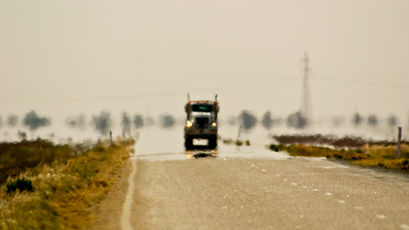
Situation
Haze significantly degrades a soldier's visual performance by:
- scattering light
- reducing chromatic and spatial contrast
Loss of Contrast:
Atmospheric haze (such as blue haze) acts as a source of veiling light that washes out target edges and lowers target-to-background contrast. [1, 2]
Reduced Visual Range:
Distance target acquisition is severely hindered because fine textural details and silhouettes blend into the scattering luminance of the atmosphere. [1, 2]
...like what...!?... - like a vehicle license plate...!... - owhhh..!...
Target Misidentification:
Degraded clarity impairs depth perception and target recognition, increasing the risk of misidentifying personnel, landmarks, or threats in operational environments. [1]
...like 3 dudes...
...which is which... ...at what range... ...with all the glare......yeah...
Photostress and Glare:
Ambient scatter amplifies glare from surrounding light sources, slowing down a soldier’s visual recovery time. [1]
...like what...?...
Photostress recovery time (PSRT) is the time it takes for a person's vision to return to normal after their retina is exposed to a bright light. [1]
What is the Photostress Test?
Definition: A clinical eye test measuring how fast retinal photoreceptors regenerate visual pigments after being "bleached" by an intense light. [1, 2]
Procedure: A bright light (like a penlight or ophthalmoscope) is shone into the eye for about 10 seconds. The time required to read lines on a vision chart again is then recorded. [1, 2, 3]
Purpose: It helps eye doctors figure out if vision loss comes from a problem in the retina/macula versus a problem behind the retina, such as an optic nerve defect. [1, 2]
Recovery Time Guidelines
Normal recovery: Usually between 15 to 30 (or up to 50) seconds.
Abnormal recovery: Taking 90 seconds (1.5 minutes) or longer often points to a retinal issue like maculopathy, diabetic maculopathy, or age-related macular degeneration.
Optic neuropathy: Patients with optic nerve issues typically maintain a normal recovery time even if their baseline vision is low. [1, 2, 3, 4, 5]
Dietarily Derived Retinal Pigments
- lutein and zeaxanthin are carotenoids. [1]
What They Are
Xanthophyll subclass: They belong to a specific group of oxygen-containing carotenoids called xanthophylls.
Dietary origin: Animals and humans cannot make these pigments in the body, so we must get them from our diet.
Food sources: They are found in dark green leafy vegetables (like spinach and kale), corn, and egg yolks. [1, 2, 3]
Role in the Eye
Macular pigments: They travel through the blood and accumulate in the retina, specifically in the macula.
Light filtering: They absorb blue light to protect delicate eye tissues from damage.
Antioxidant defense: They act as antioxidants to clear out harmful reactive oxygen molecules in the eye. [1, 2, 3, 4, 5]
-> NEED to access the retinal pigments increased via consuming the food sources as listed with high levels and perform the bright light PSRT tests...
...yes...
...then...we know...
...the impact of carotenoids on eyesight...
...can be high...
...it...
...owhhh... ...and test without...
...before consuming the food...
...would...!...
Visual Pigment Regeneration
Dietary Absorption: When you consume preformed vitamin A (retinol) or beta-carotene from food, the gastrointestinal tract absorbs it within a few hours alongside dietary fats. It is then carried to the liver for storage or dispatched to the eyes. [1, 2]
Dark Adaptation (Pigment Regeneration): Inside your eye, when light hits your retina, it bleaches your visual pigments. For your body to "re-absorb" and regenerate these retinal-based pigments to see in the dark, it takes roughly 20 to 30 minutes for full dark adaptation.
... ...time we know...
...and in "the west"...
...
...owhh...you got that different...!?...
...
...mmmm...



Comments